Morse code remains one of the most intriguing communication systems ever invented. Developed in the early 19th century, this system has endured, serving not only amateur radio enthusiasts but also those in emergencies or even within pop culture. While many understand how letters work in morse, fewer realize that numbers in morse code are just as crucial to its symbolic language. Exploring the logic behind these numeric codes reveals the smart design at the heart of international morse code.
How do morse code numbers work?
Morse code transforms both letters and numbers into sequences of short and long signals—commonly known as dots and dashes. Numbers occupy a unique spot on the morse code chart, following a specific pattern that sets them apart from the way letters are encoded.
Each digit from zero through nine features its own distinctive dot and dash representation. Understanding these patterns can make it much easier to master the numeric side of the morse code alphabet.
The structure of morse code numbers
Morse code numbers use a systematic approach that differs from the encoding of individual letters. This regular method simplifies learning and transmission, making it easy to distinguish between numeric sequences and text in any message.
The consistent handling of numbers in international morse code benefits both speed and accuracy for radio operators and anyone using a morse code translator today.
The pattern behind number codes
The cleverness of morse code numbers lies in their five-symbol sequences. From 1 (one) to 5 (five), each number starts with a growing number of dots followed by dashes. Then, from 6 (six) to 0 (zero), the sequence reverses—beginning with more dashes before finishing with dots.
This consistency makes learning numbers in international morse code relatively simple when compared to the wide variety of possible abbreviations or punctuation marks.
List of morse code numbers
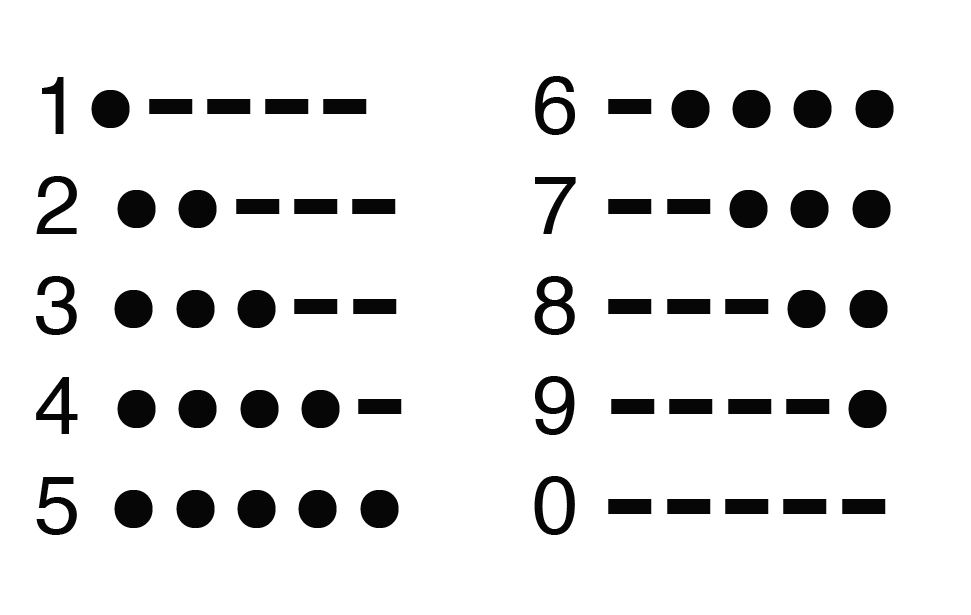
Here is the encoding for each digit from 0 to 9 using dots and dashes:
- 0: ――――― (Five dashes)
- 1: .–––– (One dot, four dashes)
- 2: ..––– (Two dots, three dashes)
- 3: …–– (Three dots, two dashes)
- 4: ….– (Four dots, one dash)
- 5: ….. (Five dots)
- 6: –…. (One dash, four dots)
- 7: ––… (Two dashes, three dots)
- 8: –––.. (Three dashes, two dots)
- 9: ––––. (Four dashes, one dot)
This logical progression highlights the thoughtful design behind the morse code chart for numbers.
Practical uses and applications of morse code numbers
Numbers appear in nearly every type of message—whether expressing quantities, coordinates, times, or identification codes. Before reliable voice communication, being able to recognize and send numbers in morse code was vital for ships, airplanes, and military units relying on radio telegraphy.
Today, digital technology may have replaced some manual skills, but morse code numbers still matter for hobbyists, scouts, and search-and-rescue teams who need an alternative way to transmit important numeric information during emergencies.
Using cut numbers for efficiency
“Cut numbers” are abbreviated forms used by experienced radio operators to save time and bandwidth. These involve shortening whole digits with simpler morse elements. This shorthand is especially useful in competitive or high-speed radio contexts, although mastering standard representations remains essential for clear communication.
While learning cut numbers increases efficiency, sticking to the full versions listed on the morse code chart offers maximum clarity—especially for formal messages or beginners.
Numbers, abbreviations, and punctuation in morse code
Beyond basic digits, international morse code includes common abbreviations and special symbols like slashes or decimal points. Each character—letters, numbers, or punctuation—must be separated clearly to avoid confusion.
Some frequently used abbreviations combine numbers and letters, showing both the flexibility and potential challenges of mixed encoding. Recognizing where numbers begin and end ensures that key distinctions remain clear. Together, numbers, punctuation, and the morse code alphabet form a robust system for communicating across long distances.
Tips for learning morse code numbers
Mastering morse code numbers might seem daunting at first, but several strategies can ease the process. Spotting patterns, practicing regularly, and visualizing groupings all help learners become comfortable with the required dot and dash representation.
Modern morse code translators found online allow users to practice until memorization becomes second nature, reducing reliance on charts over time.
Visual charts and grouping techniques
Reviewing all numbers together in a single morse code chart reinforces memory and understanding. Many charts visually group numbers according to shared patterns, sometimes using color-coding or linear arrangements to highlight connections.
Separating digits from letters on study materials prevents mix-ups, while focusing solely on numbers in practice sessions builds confidence and speed in decoding under pressure.
Practice strategies for fluency
Drills with flashcards or listening exercises accelerate recognition and retention. Practicing random number sequences mimics real-world scenarios, where data rarely appears in predictable order. Regular daily practice quickly leads to noticeable improvement.
Combining sound-based drills with physical signaling—like handheld clickers or finger taps—engages multiple senses and helps anchor morse code numbers in memory. Adding light time constraints introduces a sense of urgency similar to actual message situations, increasing readiness for practical use.
Frequently asked questions about morse code numbers
Are morse code numbers the same worldwide?
Yes, international morse code provides a standardized way to represent numbers from zero to nine. This global agreement means that messages containing numbers are understood by operators everywhere. There may be local jargon, such as “cut numbers,” but the main system stays the same and is recognized globally.
- Zero to nine use five-dot/dash sequences
- Pattern applies regardless of country
How does a morse code translator handle numbers?
A morse code translator instantly converts typed numbers into the correct dot and dash representation. When users tap or input morse signals for numbers, the translator deciphers the intended numeral based on international norms. Most tools show both the raw morse code and the corresponding digit for clarity.
- Automatic conversion from numerals to code
- Audio or visual feedback options available
| Number | Morse code |
|---|---|
| 2 | ..— |
| 7 | –… |
Can numbers be used together with letters and punctuation in morse code?
Absolutely, numbers can be combined with letters and various punctuation marks in morse code. Careful spacing is essential to prevent confusion between numbers, alphabetic strings, and abbreviations. Each punctuation mark—including period, comma, or slash—has its own distinct encoding, ensuring accurate message delivery.
- Clear separation enhances readability
- Punctuation aids message context and meaning
Why are there abbreviations and cut numbers in morse code?
Abbreviations and cut numbers in morse code let skilled operators send messages more quickly during busy periods or competitions. Shortening numerical codes saves valuable transmission time while keeping enough context for accurate decoding. However, beginners should always learn the standard forms before attempting advanced shortcuts.
- Faster operation, especially in contests
- Not suitable for all message types